Tuesday, September 20, 2016

The tale of the strange birth certificate, a Runcible Greevey story

In this year of so much pure political fiction and outright lies, I offer this piece of pure political fiction (and outright lies) to amuse. It is the product of a late night wandering mind. Runcible Greevey is our detective he's working on a story that even our jaundiced reader will have a hard time believing. Here’s what he knows ...

It's springtime in the year 1943 and General Paulus has already been transported to Moscow. His German 6th Army is in collapse. Defeat at the hands of the Bolshevik Zhukov has left the German high command stunned. German prisoners have been dying by the score as they are force-marched through the late winter's bitter cold to labor camps throughout Russia. Only weeks before, Joseph Goebbels has given his famous speech in Berlin’s Sportpalast in which he calls for Total War and the extermination of the Jews. Hitler, for the first time, is worried. He is also reeling and furious. 

So, what does der Fuhrer do on that unusually warm April night in the Berchtesgaden? He turns to his lover Eva Braun, for solace, for comfort. The Fuhrer and Eva are together just that one night, but it is a night that would have consequences down through the ages. You see, Eva Braun got pregnant that night. Adolf Hitler would have a child. 

They hid it from the cameras. Eva was discreet, she didn’t go out in public hardly at all, and when she did, she clothed herself in a way as to not let on that she was “with child,” as the phrase used to go.

In the quiet confines of the Eagle's Nest, away from the prying eyes of the German public, only a few were allowed to see the newborn. Blond hair, this child suckled and cried as babies do, nestled in the Bavarian alps, away from everyone.

For the adults gathered around the crib, the war wasn't going well. Talk of defeat was punishable by the firing squad or the hangman's noose, but this didn't stop even the most senior generals from nervously fidgeting their cigarette as they contemplated the year ahead of them. 

What happened to that child has been the speculation of many for ages. This is where Runcible comes in. Runny has been working on this story for quite some time, and he’s been able to ferret out some facts. The child was a boy. This much Runcible deduced from Braun's correspondence with her family, letters captured by the American 3rd Infantry Division at the end of the war. We also know that during the first year of his life, he was a sickly child, often given to coughing fits. 

And we know this too. There were Nazi sympathizers in the American divisions responsible for the occupation of southern Germany in May and June 1945. These individuals existed throughout American units, including the 7th Infantry Regiment who first controlled the area in southern Bavaria that Hitler called his vacation land.

While the Soviets were racing onto Berlin in May of 1945, this child was still in the south. He was found by American soldiers and was identified as Hitler’s child. Sympathetic American Nazis in the U.S. Army had him transferred to the United States in one of the many Displaced Persons ships then crossing the Atlantic. 

It was the hope of both German and American Nazis that this child would one day grow up to reinstate the vision that the Nazis had had for Europe, and one day destroy his new homeland, the country that gave this person a chance at a new life as his parents committed suicide in a subterranean bunker in Berlin as the Russians closed in. 

Of course, finding a home in America wasn’t hard. The child’s handlers settled on New York City. It’s such an easy place to disappear, and at the end of the war there were so many people flooding into and out of all the boroughs. In Queens, New York to be exact, a family was identified. Sympathetic to the larger cause, they were more than happy to take in a child like this. They would provide this child a home and an upbringing. What he turned into, that would be up to him.

Papers were not hard to secure. All it took was a friend down at the Immigration Office, and bingo, papers magically appeared. Appear they did. Born in 1946, the documents say. That is what they say. Runcible Greevey is on to all of this, and his hard-charging sleuthing is exposing this now, just in time for us to know who this person is, who claims to be born in 1946. In 1946, that's what his papers say. But Runcible is on to him.

Friday, September 16, 2016

Riding the Red Line, in Cambridge

The Red Line is the artery that keeps Boston's economic and social blood flowing. It's the public transit line that connects family and friends, workers and their jobs, tourists and their destinations, all the way from Alewife to Braintree and all points in between.

The Red Line has long been on my list of fascinating local pieces of infrastructure because it's the major connector of so many important parts of Boston and Cambridge.

Along its 22 stops, it connects Tufts, Harvard, MIT and UMass Boston with the political centers of Cambridge City Hall, Boston City Hall and the state legislature on Beacon Hill. It connects business and retail centers to the innovation hubs at Kendall Square, South Station and increasingly at Downtown Crossing as well. All the while, it's moving 275,000 people a day.

I decided to take a tour on it, stop by stop, and I compiled some photos from Segment 1 of my tour, the stations and surrounding areas in Cambridge. Here is Cambridge via the Red Line. Happy Friday.


Kendall ...


Central ...


Harvard ...


Porter ...


Davis ...


Alewife ...


Wednesday, September 14, 2016

Workbar, partnering with Staples, opens in Brighton

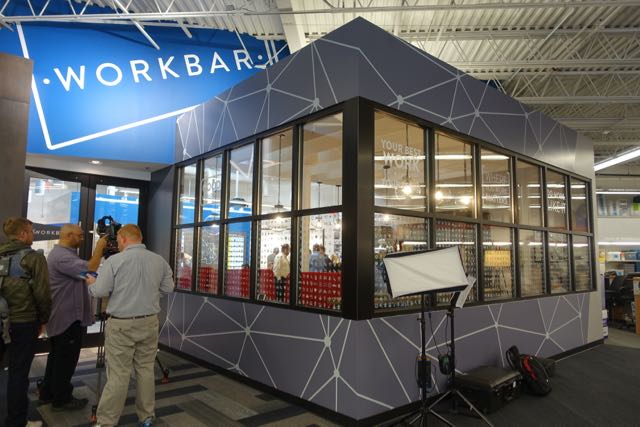
Workbar, the co-working space with locations in Cambridge, downtown Boston and Somerville, opened its newest location in Brighton yesterday, and they invited friends and the media out to take a look. Here's what we saw ...

Lots of media on hand


Their newest location at 1660 Soldiers Field Road is nested inside a Staples store,

It's literally a store within a store


in a nondescript parking lot in Brighton.

Interesting fact: Staples first ever store opened in this same parking lot back in 1986
By partnering with Staples, Workbar all of a sudden has a host of possible locations to grow its co-working spaces into. By choosing Brighton, along with Danvers and Norwood for its initial sites outside the urban core, Workbar now has broader reach out into the suburban market. This is a wise choice. By moving close to the suburbs, Workbar will be able to test if the co-working idea can thrive in lower density locations and away from public transit.


Co-working, catching on, even in more suburban locations


My own belief is that they will succeed beyond their expectations. The pent up demand in the suburbs for this kind of work space will be strong, I believe, because there are many people who are locked into a suburban lifestyle that prevents them from more effectively becoming a part of gig economy. Workbar's proximity will provide them a welcomed relief valve.

It will also be very interesting from an urban planning perspective to see how the presence of Workbar customers begins to impact the surrounding environment. Staples may decide that it now needs to help the create food options nearby, and the auto-focused world will add new amenities such as Hubway and Zipcar.


There was a buzz of excitement yesterday as Workbar staff gave tours and people came to interview Workbar founder Bill Jacobson and see the portrait of Staples founder Tom Stemberg on the wall.

People arriving for a tour, Bill Jacobson in the vest


Workbar head of operations Emily Knight, looking at Staples founder Tom Stemberg


Sunday, September 11, 2016

Leslie Whittington, d. September 11, 2001

Today I think of Leslie Whittington, an economist and associate professor of public policy at Georgetown University who was killed along with her husband Charles Falkenberg and their two children Dana and Zoe when terrorists crashed American Airlines Flight 77 into the Pentagon on September 11, 2001. Leslie and her family were on that plane, heading to Australia for her fellowship at the Australian National University.

An associate dean at what was then called the Georgetown Public Policy Institute when I was a student there, I remember Leslie as kind and witty and warm. Though I never had her in a class, I knew her from around the school, which was housed in a small building near the Georgetown campus.

In the days following 9/11, fellow GPPIer Francis Creighton emailed me and other classmates informing us of her death.

I think of her today, now 15 years later, and I am happy to know that Georgetown remembers her with The Whittington Lecture.

She was a good person.


Friday, September 9, 2016

Friday Grab Bag: Toomey's out, Connolly's in; Housing in Cambridge; Photos in NYC

In local politics
Tim Toomey lost to Mike Connolly yesterday in the 26th Middlesex district. As readers of this blog will know, I backed Tim. But the first order of business after an election is to congratulate the victor and wish him well. After all, one of the most important guarantors of liberty is the peaceful transition of power.

Congratulations Mike, you did it!

Upon hearing of Tim's loss, I was remembering the first local campaign I paid close attention to -- Avi Green's attempt to unseat him in 2004.

Avi raised a lot of money and ran a strong campaign and knocked on a lot of doors but was not able to beat the power of incumbency that September. Tim's legacy was long and his roots in the community were deep. Still, the Avi supporters said, "Just wait, it's only a matter of time before Tim loses one of these. The demographics of the district are changing. The old people are dying out and young people are moving in." As the case would be, it took 12 years but that day has finally arrived.

Something else has change over the intervening 12 years, something not usable to Avi but available to Mike. The technology of mass communication has become much more sophisticated and subtle. Doing a quick search on Avi's race, I came across this posting. To look at it is to see how quaint internet outreach efforts were in 2004. Compare this to 2016 when voters received day-of text messages reminding them to vote for Mike, messages they then posted on Facebook as humorous commentary on the voter outreach efforts.  It only goes to say that the world has changed a lot in a short amount of time.

We wish Mike well in his new role. Love Tim or hate him, he worked hard for his district, and he was there for them when they needed him. Mike should try to emulate him in that if nothing else.

Housing in Cambridge
Meanwhile, back in Cambridge local policy matters, the Housing committee of the City Council met yesterday to discuss the proposal to raise the inclusionary zoning requirement to 20 percent. This is a topic that has been under review for quite some time now, with some housing advocates calling for 25 percent of all new housing units to be affordable, with developers asking for 15 percent and a phase-in up to 20 percent, and the city's consultant on this issue calling for 20 percent. It's a classic political football in the sense that no one knows exactly the workable number to cause developers enough pain, create enough units yet not shut the system down by making everything too expensive, so people are using their best guess and then filtering that through their ideological or their fiscal lens and trying to make that argument stick. I, as a member of A Better Cambridge, wanted the committee to know that ABC cares about this issue and will continue to track it moving forward.

Two key observations that have come from internal ABC's discussions of the issue:

  1. The only way to produce affordable units through inclusionary zoning is by producing market rate units too. That means that we must build more units overall, which also means that the Council should continue to examine the issues of height and density in this city, to see where taller higher-density buildings are appropriate.
  2. The absolute number of new units created is more important than the percentage number agreed to in the formula. Another way of saying this is: 10 percent of 100 units of housing is 10 units of affordable housing, whereas 20 percent of 10 units is 2 units of affordable. While we would have adopted a higher percentage in the second scenario, we would have eight fewer units of affordable housing. So we might have won the battle, but lost the war. At the end of the day, a percentage is just a number, but an actually housing unit is someone's life.

There will be much more process and many more meetings before anything gets etched in stone, or at least in the ordinance books. How to create three-bedroom units, whether there should be a one year phase-in period, who exactly is subject to the new ruling and whether or not there is a grandfathering provision, these among others are all to be decided, so stay tuned.

Photos in NYC
Finally, in a totally unrelated note, I traveled down to New York City last weekend, where I had the chance to snap some photos, which I add below because New York is such a great place to snap some photos. Happy Friday!


Feet, NYC subway

Christ in a box

Geometric shapes, West Side of Manhattan

Hudson Yards

Weegee attempted, 54th Street

Freedom Tower, lower Manhattan


Friday, September 2, 2016

Tim Toomey for State Representative

On September 8th, Democrats in the 26th Middlesex district will make their choice for state representative, and that winner will almost certainly go on to win in November. Incumbent Tim Toomey is facing challenger Mike Connolly.

I served on the City Council with Tim, and I've known Mike for a few years now, starting during his days as an activist now this, his third bid for public office.

My view? The voters of the 26th should re-elect Tim Toomey.

I had the chance to watch Tim up close when I was on the Council. He was always a very good barometer of what was fair. He demonstrated over and over again that his deepest concern was for people who may not be graduates of Harvard or MIT but are grounded in Cambridge and its neighborhoods, who tend to see the world as a set of common sense trade-offs not as ideological battle cries, who are open-hearted and open-minded. Tim was their voice and he is still needed.

Some might say Tim is a throwback to a time that has past or that he's too local. Actually, he's the best representation of what local politics should be all about. He fights relentlessly and tirelessly for that group of people who cannot buy themselves out of a problem. He has only ever insisted that everybody be treated fairly. No special breaks for the rich or different treatment for the powerful. He is focused on the actual issues that matter to real people, not the ideological tests that consume the activists. He is all about making a positive difference in the lives of his constituents.

Tim should continue in the State House. He is a public servant who has proven his ability and fights hard for those people who need it most. The voters of the 26th should hear his request to continue to serve, and they should make it so.


Wednesday, August 31, 2016

Frederick Douglass speaks

Now in this summer of our discontent, words from Frederick Douglass seem not inappropriate ...


It is not light that we need, but fire; it is not the gentle shower, but thunder. We need the storm, the whirlwind, and the earthquake. 


Those who profess to favor freedom, and yet deprecate agitation, are men who want crops without plowing up the ground. 


At a time like this, scorching irony, not convincing argument, is needed. 


No man can put a chain about the ankle of his fellow man without at last finding the other end fastened about his own neck. 


A battle lost or won is easily described, understood, and appreciated, but the moral growth of a great nation requires reflection, as well as observation, to appreciate it. 

Tuesday, August 30, 2016

Colin Kaepernick is a brave man

Colin Kaepernick is a brave man. About that there can be little doubt.

His detractors, at least some of them, are not known for embracing subtlety or tolerating opposition. The American football-watching male has been trained to shout his views and belittle his opponents. Indeed, I have long felt that one of the responsible parties in the rise of Donald Trump has been sports-talk radio, with its endless bombast and argument-structure that celebrates winning at all cost and giving no quarter.

Colin Kaepernick is staging a protest. Protests should not be mildly inconvenient. They should shock the conscience to awaken the senses. A protest should raise hackles. A few weeks before his death in 1895, Frederick Douglass was asked what advice he would give to a young black American, "Agitate, Agitate, Agitate!" the old man answered. By calling into question the whole premise not only of our national anthem, but also the rituals surrounding our multi-billion dollar sports entertainment industry, Colin Kaepernick clearly is hearing Frederick Douglass.

In this simple action, or lack of action in this case, Kaepernick also points out the exploitative nature of professional sports, which use people to prop up this vast wealth-making machine only to discard them where they become too old or too damaged to thrill. Such a moment might arrive after 20 years of glory-filled plays or it could be after 20 minutes and a blown-out knee. That a professional football player can be lauded under the lights for 60 full minutes by 70,000 fans and then subject to dangerous interactions with the police on the way home when he pulls over with a flat tire is just one of the societal misconnections we Americans must address.

Much like the 1968 Mexico City Olympic protests that so indelibly seared a generational image into our national mind, Colin Kaepernick in his gesture has done something much braver and bigger than most. It certainly ridicules the white liberals who harangue other white liberals over their bona fides in the Black Lives Matter movement.

Colin Kaepernick has single-handedly ... and alone ... taken the fight to the lion's den. We wish him well.