Saturday, June 1, 2013

Innovations in planning

This past week, the Metropolitan Area Planning Council held its annual meeting in the drab desolate spectacle called the Marriott Hotel in Quincy, MA.  Getting to the meeting was no joy either -- a 25 minute ride on the Red Line down to the Quincy Adams stop was augmented by a 20 minute walk from the T station to the hotel on sidewalks that could claim nothing other than being afterthoughts in a world made entirely for the automobile.  That urban environment is a perfect example of why we will spend the next 30 years trying to undo the last 50 years of planning and construction. 

Being at the conference however was better than the trip there.

Ever since my panel discussion at Harvard's GSD on innovation districts this past April, I have been thinking about innovation in planning.  The panel spent two hours trying to understand how "innovation districts" work and why they work, but it occurred to me at the end of that session that the next question is not how the districts help to encourage innovation, but what planning itself needs to do to innovate and incorporate some of the new capabilities that exist through technology.  I think it was Nicole Fichera's wrap up question that got me to that thought.

This week's MAPC meeting brought me back to it.  In one presentation, a transportation planner argued that interventions will happen better by testing out possible options before making the full investment.  A temporary bike lane with cones in the roadway will show more than a six-month planning process ever could.  At least that is his thesis, one which I fully support.

He was really asking -- can we problem-solve through an iterative approach?  Must we always plan before we act? These questions are not at all dissimilar from what happens in innovation districts.  Trying and then trying-again is one of the fundamental aspects of our innovation economy.  The can-do attitude of most entrepreneurs  follows this path, and the investment money in the innovation world certainly supports it.  Not every dice roll needs to come up double-sixes.  It's an interesting concept for a high-tech startup, but an even more interesting way to think about a city. 

There can be no better example of this than what is happening in Las Vegas right now.  Downtown Las Vegas is being rebuilt currently by an energetic team of youthful dynamic leaders almost none of whom have traditional urban planning or design backgrounds.  What they do have is confidence, energy, access to money, and a belief that the same qualities that make the start-up world go can also be applied to cities where the return will come not in dollars but in community value.  What they are doing has huge implications for the future of cities in the United States and globally.   This is a fascinating study of 21st century urban planning in which planners are not being asked to participate.

The example in Las Vegas is familiar these days -- Tony Hsieh, the founder of the online retailer Zappos, decided to move his company from a suburban office park in Henderson, NV into the heart of downtown Las Vegas, 20 miles away, to draw and retain talented workers.  Yet it posed many significant challenges: the new headquarters is surrounded by nothing but vacant parking lots.


The land that the Zappos/Downtown Project will be redeveloping, across from the new Zappos HQ

To manage this complex development challenge, Zappos created Downtown Project, a group that is re-building a city from the ground up.  They are defining success by some of Ed Glaeser's metrics in his book The Triumph of the City.  It remains to be seen what this lack of urban expertise will mean for their results.  What is undeniable is that this team is approaching their many challenges with a high degree of creativity and willingness to risk.

Both of these examples point to a concept I find very powerful, "The City as Platform", and they ask the question: Can you iterate a city? In some ways, the answer is obviously yes.  That is what cities are, after all: iterations of design, construction, market, demographics, management, politics, outside forces, broader economic trends. But can you iterate a city quickly?  That answer is probably no.  Development projects by their very nature are long-term investments, both of capital and also of concept.  Undoing something that took ten years to move from initial design through permitting to construction and occupancy is not likely to be undone hastily.  Yet this is exactly the large question that the Downtown Project folks are putting to planners.  Their energy is infections and their confidence sincere.

The MAPC meeting wrapped up on Wednesday and then offered a tour of downtown Quincy, which points to the final innovation in planning.

Quincy, Massachusetts is an ancient city by North American standards, and birthplace of two American presidents, John Adams and John Quincy Adams.  It is also in the midst of a large redevelopment effort partnering with Street-Works, a private development team.

Street-Works comes across as an innovation in handling urban infrastructure investment costs.  The Street-Works model is that the city does not do all the hard investment up front and then go out and solicit bidders to come fill in the rest -- by the S-W accounting, this is the traditional model of urban re-development, and generally  doesn't work particularly well.  Instead, what S-W does is build infrastructure as needed.  They own the infrastructure until such time as the city buys it back from them.  Meanwhile, by prior agreement, the landowners in the zone where this work will happen have agreed to cover the cost of these improvements through an additional levy.  Does it all work?  According to S-W it does, based on their experience in Connecticut.

Street-Works co-founder Richard Heapes explaining the model of downtown Quincy
It has a strong component of privatizing the public realm (and responsibilities), but with the notion that the tax-payers are not stuck holding the bag for improvements that most communities can never afford to make.

Altogether, these three examples are efforts to rethink planning and its processes both at very large scales and at much more micro scales.  These approaches, and many other related efforts to re-think anew, will be the thread in planning over the next two decades.

Thursday, May 23, 2013

Michelle, ma belle

My friend Michelle Cottle recently emailed me that her friend Norman Kelley is raising $10,000 to finish a movie about Charlie Peters, the founding editor of the The Washington Monthly.

What Michelle, a former TWM editor herself, neglected to tell me was that she had just had a bilateral mastectomy.  She only alluded to it by pointing me to one of her links -- what she had written about it: 

http://www.thedailybeast.com/witw/articles/2013/04/24/when-a-full-mastectomy-isn-t-a-terrible-event.html

It catches you, news like this.  It really catches you.

With such hard news, I sent her a link to a Burt Bacharach song.  That may be a laughable statement, but it's true.  Straight out of the Brill Building in Manhattan, Bacharach and his song writing partner Hal David got the 1960s right on the mark and wrote a beautiful lyric when they wrote: "What the world needs now is love sweet love ..."

At the risk of triteness, what Michelle had was not breast cancer, it was courage. Both courage and language.  Language to talk about it.  Courage to endure it.  Courage to share it.

These are words that go together well.

You can hear a wonderful YouTube medley of Bacharach tunes played by Stevie Wonder, Arturo Sandoval, Diana Krall, Lyle Lovett, Sheryl Crow, Shelea and others at a White House ceremony for the Gershwin Prize here:

http://www.youtube.com/watch?v=ky3r1V7-IeQ

=================

You also can support Norman Kelley's efforts to record the importance of Charlie Peters and TWM by going to his website where he's running a '100 x 100' campaign to raise the funds.  Both Charlie and TWM are Washington institutions, and for good reason.  Peters is the apostle of a brand of journalism that does not renounce opinions but embraces them.  Foremost among these is the thesis that government can do good and should try.  Its creed seeks neither softness nor toughness per se but honesty and a secular faith that our capacities are to be admired and employed, not denigrated and hamstrung.  His magazine meanwhile has served as a starting point for many of Washington's best writers, editors, and journalists for decades now. 


Friday, May 17, 2013

Friday Grab Bag: Descartes, bodies, carpets, Cleopatra

It's a Friday, and it's been a little while since I've posted and a long while since I've posted a Friday Grab Bag.  After all we've been through, it's spring finally and beautiful in Massachusetts today.  This leads me to think that some random thoughts on random topics with no discernible thread is what people need.  So, here goes.

Friday philosophy (complete with a dead body). Think about this sentence for a minute: "Police confirmed yesterday that the body found floating in the river belonged to Sally Jones, a sophomore at the local community college who had been missing since last Friday."  While this sentence is made-up, it nevertheless could appear in a newspaper article reporting on an ongoing investigation. What's interesting to me is this -- what can it mean for a corpse to "belong" to someone? It makes no sense.  The body is not in my opinion distinguishable from the "self" and furthermore, even if it is, the "self" referred to in the sentence is dead, and therefore no longer able to own anything.  This is a case of Miss Marple meeting Rene Descartes and the offspring not being too pretty. 


Cleopatra dons a disguise. On a completely other note, I was talking to a 7th grader the other day and she was telling me about her project on Cleopatra (queen of ancient Egypt famed in part because of her relationship with Marc Antony and in part by her dramatic demise by an asp).  Of the facts she related to me about Cleopatra's life was this one that I did not know (retold here by me using her emphases):

Long before Marc Antony, Cleopatra was intrigued by Julius Caesar who was in the process of installing himself as the first emperor of Rome.  Cleopatra wanted to meet Caesar but going to Rome overtly would have been a complicated issue politically, so she opted for another method -- clandestinely.  Of course she would travel by ship, but how could she be on the ship without being spotted?  Her answer was to go to Rome rolled up in a carpet, a carpet that would be delivered to Caesar as a gift, and which when unrolled would produce this woman, the queen of Egypt.

A fabulous story, though it is hard to imagine what the travel accommodations were like.

Note: Wikipedia fills out the story wonderfully and dramatically and gives a much more accurate telling of this story, correcting my bad information, such as -- this happened in Alexandria, Egypt not in Rome, and Cleopatra sought Caesar as a trump card in her power struggle with her brother Ptolemy.  The fact that she had Caesar's child 9 months after the "carpet encounter" is an interesting fact too, as is the source of this tale, Plutarch.

Of course there have been many images made of Cleopatra over the centuries, so pivotal is her story to our imaginations.

Here are two separated by 19 centuries:


Cleopatra.  Egypt, ~30BC

Cleopatra meets Julius Caesar.  French, Jean-Leon Gerome, ~1867.

Friday, April 26, 2013

A city. A shutdown. A suspect. And us.

It beggars the mind to jot down last week's events in Boston and Cambridge and Watertown - Monday's two bombs near the finish line at the Boston Marathon that killed three and wounded many more; the release of the video footage identifying the suspects and possibly precipitating Thursday's very violent night -- the robbing of a 7-11, the killing of MIT police officer Sean Collier, the car chase from Cambridge into Watertown and the shootout in Watertown that killed one of the suspects and sent the other one into hiding; finally, Friday's day-long manhunt for suspect number 2 culminating in his capture while he bled under a tarp in a boat parked in a backyard.  The first of funerals have taken place, and if injury weren't enough, Westboro Baptist Church showed up to add insult.  Teamsters Local 25 set up a human chain to protect the mourners. This week, Cambridge City Hall held a minute of silence and Officer Sean Collier was remembered by the MIT community with Vice President Joe Biden in attendance.

I still cannot grasp the meaning of last week's events though many good efforts have been made to parse them.  As an urbanist, I am interested in what this says about cities, though I must concede that Shakespeare probably got it best when he asked "What is the city but the people?"

Many smaller stories tile the larger people mosaic -- the police officer able to weep only in the solitude following Officer Collier's funeral; the acquaintance's girlfriend who got shrapnel in the chest from the exploding backpack; the friend woken on Thursday night to the sound of a war on the street outside her house in suburban Watertown; these cannot be minimized.

What transpired on Friday, however, is equally baffling. What can it mean when a whole urban area of over 1 million people comes to a self-imposed halt so that law enforcement can pursue one man?  Where have we come to, and should we be happy that we are there?

The day certainly showed not only the determination but the capabilities that America and an American city can bring.  Within four days after the bombing, one of the suspects was dead and the other was in custody, wounded. 

This incredible law enforcement capacity exists for a host of reasons - training, cooperation, technology.  But there are other reasons too. The streets on Friday offered not a soul nor a sound other than the wail of sirens of motorcycle police joined from time to time by the rumble of heavy trucks rolling down the center of the street, canvass-topped and painted in the light tan color appropriate for desert warfare.

The streets were empty because the people stayed inside, in response to a "shelter in place" statement by the governor, a statement that was not an order, but a request. 

How does such a request produce such a result?  Social media must be a crucial element.  Only by our interconnectedness - the fact that we are wired to each other and to the web - could Friday's complete shutdown occur.

It brought results.  Still, it produced worries too.  Ought we have been more circumspect? Do we risk group-think building a momentum of its own with unsettling and potentially dangerous outcomes?  Simply believing that we act for the right reasons does not protect us from being wrong, which is only a rephrasing of the aphorism that "the road to hell is paved with good intentions". 

The confirmation on Thursday that the body found floating off India Point Park in Providence, Rhode Island this week belonged to 22-year-old Brown University student Sunil Trepathi points out the danger.  Wrongly identified by online sleuths as one of the bombing suspects, Trepathi's name was blasted around the Twitterverse as if he should be sought by the FBI.  The viral nature of the accusation got so bad - while so completely unfounded and incorrect - that the editors of Reddit later apologized to family for what they described as a "witch hunt". The family no doubt appreciated the contrition, but the Genie had left the bottle.  The family issued this statement:

"As we carry indescribable grief, we also feel incredible gratitude.  To each of one  you -- from our hometown and to many distant lands -- we extend our thanks of the words of encouragement, for your thoughts, for your hands, for your prayers, and for the love you have so generously shared.   
"Your compassionate spirits is felt by Sunil and by all of us.  This last month has changed our lives forever, and we hope it will change yours too."
They concluded: "Take care of one another.  Be gentle, be compassionate.  Be open to letting someone in when it is you who is faltering. Lend your hand. We need it.  The world needs it."

In the odd paradox of the human spirit, those who have the most legitimate reason for hardness often evince the opposite and ask others to do the same. 

It is always tempting to assume we have entered some new era, that technology has fundamentally changed us, that "history has ended" -- to quote one of the great whoppers promulgated after the fall of the Soviet Union.  History hasn't ended. Technology has changed many things, but it hasn't fundamentally changed us, and as Americans, we have an obligation to maintain  the most important aspect of our freedom -- the weary, wary sideways glance by which the governed and the governing view each other. 


Thursday, April 25, 2013

Surely some revelation is at hand.

For some reason, two lines from William Butler Yeats' poem "The Second Coming" have been rattling around in my head over these past few days:
The best lack all conviction, while the worst   
Are full of passionate intensity. 
To whom these lines apply, I know not, but Yeats said many things well. This is no exception.

You can read the whole poem here.

Sunday, April 14, 2013

Innovation Districts: Fad or Future?

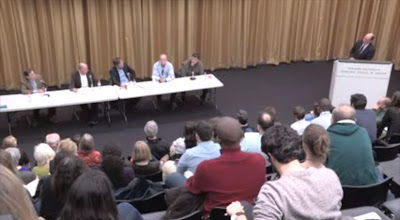
Are innovation districts a passing fad, or are here to stay?  This was the motivating question behind a panel discussion I moderated at Harvard's Graduate School of Design on April 3.

Watch the discussion here:


The event was organized by an ambitious group of planning students at the school, and in the course of preparing it, we covered many aspects of innovation districts and developed a series of important, interrelated questions about what they mean.  Here's how we phrased it:
Innovation Districts are all the rage, with cities around the world attempting to create them. What makes them work?  What are their local and regional implications?  Can they be planned, or must they occur organically?  Can they be replicated? These are just some of the questions to be discussed by a panel of experts on April 3 at Harvard's Graduate School of Design.

The distinguished panel consisted of:
  • Tim Rowe, founder, Cambridge Innovation Center
  • David Dixon, principal, Goody Clancy
  • Guillaume Pasquier, deputy director, Paris Saclay
  • Gavin Kleespies, executive director, Cambridge Historical Society
  • Marc Draisen, executive director, Metropolitan Area Planning Council
Click on the link above to watch the discussion.

Tuesday, March 26, 2013

New Construction: These numbers just in.

In 2012, Cambridge witnessed groundbreakings for over 1.8 million square feet of new construction, almost all of it in Kendall Square.

Meanwhile across the river in Boston, three million square feet of new construction is underway right now in their innovation district, with another 20 million planned.

This deserves an exclamation point! These are very large numbers in very small geographic areas.  If ever there were statistics that screamed "Cities are the 'it' thing in 2013", these would be them.

We're a long way from 1975.

Monday, March 25, 2013

Remember to chew before swallowing.

After Mitt Romney's crash and burn in the 2012 elections, the radio waves were alive with anger, gloating, recriminations and analysis over the outcome.  Sensible people on the right (which means only not on the extreme fringe) pointed out that this is the fifth time in the last six presidential election cycles that the Republicans have lost the popular vote.  Of course that's true.  Starting in 1992, in every election but one, Americans have chosen the Democrat over the alternative: Clinton, Clinton, GORE, <Bush>, Obama, Obama.

Still, the wisest observation I heard about GOP's problems boiled down to this: "George W. Bush is an undigested political fact in the Republican Party."  

Also true. Without facing the long trail of destruction that Bush 43 and the neo-cons left in their path (dare we call it their "trail of tears"), the Right's hope of building a winning national coalition will be held back a generation at least.  My advice: Start chewing.